Tuesday, January 21, 2020

Deconstruction

Monday, 20 - January - 2020
Deconstruction

Hello Reader...

Today I'm sharing one more Blog about Deconstruction. This blog task is about how apply Deconstruction in movies, poems, novel or any book which we like. And we all are try to apply Deconstruction in this things. This is our today's take by Sir. ( Click here ) .


# Dictionary meaning of Deconstruction.

A method of critical analysis of philosophical and literary language that emphasizes the language and conceptual systems of internal workings, the meaning of the relational quality, and the assumptions implicit in the expression of forms.

Deconstruction is a Poststructuralist theory based on largely but not exclusively on the writings of Derrida. It is in the first instance a philosophical theory and a theory directed towards the rereading of Philosophical writings. On the fact that Deconstruction sees all writing as a complex historical, Cultural process rooted in the relations of texts to each other and in the institutions and conventions of writing and on the sophistication and intensity of it's sense that human knowledge is not as controllable or as convincing Western thought would have it and that language operates is subtle and often Contradictory ways, so that certainty will always elude us.

Deconstruction involves the close reading of texts in order to demonstrate that any given text has irreconcilably contradictory meanings, rather than being a unified, logical whole.

Derrida suggests these oppositions are hierarchies in miniature, containing one term that Western culture views as positive or superior and another considered negative or inferior, even if only slightly so. Through deconstruction, Derrida aims to erase the boundary between binary oppositions—and to do so in such a way that the hierarchy implied by the oppositions is thrown into question.

Deconstruction was both created and has been profoundly influenced by the French philosopher Jacques Derrida. Derrida, who coined the term deconstruction, argues that in Western culture, people tend to think and express their thoughts in terms of binary oppositions (white / black, masculine / feminine, cause /effect, conscious /unconscious, presence / absence, speech writing).

As J. Hillis Miller, the preeminent American deconstructionist, has explained in an essay entitled Stevens’ Rock and Criticism as Cure (1976), “Deconstruction is not a dismantling of the structure of a text, but a demonstration that it has already dismantled itself. Its apparently solid ground is no rock but thin air.”

&

I try to apply Deconstruction in both movies. Plot of the movies are diffrent from each other. Both movie narrated by any person who was the main actor in the movie. And some ways both movies based on study. In 3 Idiots movie Aamir Khan play a lead character and he think positive way in study. With our positive thoughts, can we take the first rank in the exam? 

If answer is 'No' than how can Aamir Khan got first rank in exam with his positive thinking. And we can also told that this movie also is a kind of love story, Because you also find romantic song in the movie and no end of the movie comes only after meeting the hero and heroine Aamir Khan and Kareena Kapoor. So you can call it a romantic movie.

Second movie is 2 States. The Two States movie is a romantic movie, but both the heroes and the heroin may have resorted to the study to meet the film maker. But in this movie, the importance of study is taken and study is given importance. It is also narrated by Arjun Kapoor. And although the customs of these two regions are different, the parents of the two are finally considered for marriage.

If we do not take this plot, we can look the other way. In this movie, love is given more importance at first, but then the importance of study increases. When Arjun meets Alia's father, we can also watch the movie at the base of the study.




Friday, January 10, 2020

Structuralism

Tuesday, 09 - 01 - 2020
Structuralism 

Hello Reader...

Welcome to all Reader on my blogspot. Today I present this blog with the example of movie, novel, poem and etc. things. Our Professor Dr. Dilip Barad sir giving that type of blog task for new learning methods and peoples use this method in his or her learning. So he try to do this and one day he is successful in his this mission and students and parents both are being learner in this method. So people use those things and gaine knowledge. This new learner method is so much use full for alla and everyone join this and also write and the excess anywhere for learning things.

Today's my blog about the Structuralism. Click here for Dr.Dilipsir's blogspot. This method use for looking things.

What is Structuralism?
According to me Structuralism means connection between words and emotions, hints and signs.

# According to dictionary :
A method of interpretation and analysis of aspects of human cognition, behaviour, culture, and experience, which focuses on relationships of contrast between elements in a conceptual system.

• The doctrine that structure is more important than function.

# Definition
Structuralism as a method is peculiarly imitable to literary criticism which is a discourse upon a discourse.

• Firstly, he emphasize that the meanings we give to words are purely arbitrary and these meaning are maintained by convention only. There is no inherent connection between a word and what it designates. Structuralist were interested in implication that if language as a sign says is based on arbitrariness of this kind then it follows that language isn't a reflection of the world and of experience but a says which stands quite separate frame it.
i.e,
Sign - Signifier - Signified
Dog : Image of 4 legs animal, pets animal, and also faithful to human. And help to other.

• Secondly, He emphasized that the meanings of words are relational. i.e, no words can be define in isolation form other words. All the meanings depends on other 'adjoining' words. i.e. Train on 8.25 Bhavngar to Surendranagar. And we show one other example in gujarati is " on bus station = 'છ ની બસ ગઈ?".

Thirdly, language 'constructs' our world - it does not just record or label it. Meaning is always attributed to the object or idea by the human mind, and constructed by and expressed within the things.
i.e. freedom fighters = terrorist.
                           Sign. = Mental horizon.


It has been said that there are three vision of every story.
1. Your vision
2. My vision and ,
3. The Truth.
But the case here is more complicated than that, since all the available terms are purely linguistic. There is no Truth..... Outside of the language.

# Important concepts in Genette's narratology.

Genette's narratology is derived from Narrative Discourse; An Essay in Method. Below are the five main concepts used by Genette in Narrative Discourse; An Essay in Method. They are often used to look at the syntax of narratives, rather than to perform an interpretation of them.

1. Order
2. Frequency 
3. Duration
4. Voice
5. Mood


I try to apply all this methods in the movie 3 Idiots movie. This story about three Idiots who is living there life with full of problems and they survive with joy and happiness. This story narrate by Farhan (R. Madhavan) and he have best friends is Raju ( Sharman Joshi) and Rancho ( Aamir Khan). R. Madhavan narrate this story. 


In this story starting with the ending scene. The order of the story is


Sunday, January 5, 2020

Northrop Frye

Northrop Frye's essay The Architype of literature.
Sunday, 06 - 01 - 2020.

Hello Reader...

Today I'm present one more Blog on Northrop Frye. This blog task given by our professor Dilip Barad sir about Northrop Frye's essay on The Architype of Literature.
In literary criticism the term Archetypes denotes recurrent narratives designs, patterns of action, character types, themes, and images which are identifiable in a wide variety of works of literature.


Herman Northrop Frye (July 14, 1912 – January 23, 1991) was a Canadian literary critic and literary theorist, considered one of the most influential of the 20th century.
Frye rose to international prominence as a result of his first book, Fearful Symmetry, published in 1947. Until then, the prophetic poetry of William Blake had long been poorly understood, and considered by some to be delusional ramblings. Frye found in it a system of metaphor derived from Paradise Lost and the Bible.
In 1974–1975 Frye was the Norton professor at Harvard University. But his primary position was as a professor at the University of Toronto, and then chancellor of Victoria College in the University of Toronto.Northrop Frye did not have a Ph.D.
The intelligence service of the Royal Canadian Mounted Police spied on Frye, watching his participation in the anti-Vietnam War movement, an academic forum about China, and activism to end South African apartheid.

Question - 1 : 

What is Archetypal Criticism?  What does the archetypal critic do? 


Archetypal criticism as it applies to literature is a form of criticism "that interprets a text by focusing on recurring myths and archetypes."
It was most popular during the 50's and 60's; this would have been the later part of Jung's lifetime. His work, along with other psychologist and philosophers created the ideas behind archetypal criticism.Rather than looking at the other aspects of the literary work itself, this type of criticism focuses on just the archetypes present.

However, you asked specifically about Carl Jung who was a psychologist. In this case, archetypes are usually referring to a specific behavior exhibited by a certain type of person rather than a literary example. Archetypal criticism isn't often used as a form of literary criticism now days.

Archetypes are "an original model of a person, ideal example, or a prototype upon which others are copied, patterned, or emulated." With regards to literature, this usually refers to ancient models like those from myths.He interprets literature in the light of various rituals and myths. Frye has divided  the easy into three parts. 

• The First deals with the concept of archetypal criticism. 

• The second of part throws light on the inductive method of analysis of a text. 


• The third part focuses on the deductive method of analysis. All the method fall under  structural criticism.


Question - 2 :
what is Frye trying prove by giving an analogy of 'physics to nature ' and 'Criticism to literature? 

Criticism so far ranks only as a subdivision of literature; and hence, for the systematic mental organization of the subject, the student has to turn to the conceptual framework of the historian for events, and to that of the philosopher for ideas. Even the more centrally placed critical sciences, such as textual editing, seem to be part of a “‘background” that recedes into history or some other non-literary field. The thought suggests itself that the ancillary critical disciplines may be related to a central expanding pattern of systematic comprehension which has not yet been established, but which, if it were established, would prevent them from being centrifugal. If such a pattern exists, then criticism would be to art what philosophy is to wisdom and history to action.

Q - 3 : Share your views of criticism as an organized body of knowledge. Mention relation of literature with history and philosophy. 

Every organized body of knowledge can be learned progressively; and experience shows that there is also something progressive about the learning of literature. Physics is an organized body of knowledge about nature, and a student of it says that he is learning physics, not that he is learning nature. Art, like nature, is the subject of a systematic study, and has to be distinguished from the study itself, which is criticism. It is therefore impossible to “learn literature”: one learns about it in a certain way, but what one learns, transitively, is the criticism of literature.

Question - 4 : 
Briefly explain inductive method with illustration of Shakespeare's  Hamlet Grave Digger's scenes. 

Hamlet is the great novel written by Shakespeare. Frye's concept is good to understand this book and also his method is also best fo understanding this book very deeply. Inductive method was mostly used by writer. Both method are best understand with this book. In this method specifies a journey from specific to general. Hamlet is the great book is full of sad emotions, unfaithfulness and etc. In the grave digging scene in Hamlet is a specifics scene, we made the general conclusion like, grave digger scene is centrifugal which moves us away from center. In this scene Grave Digging was effected by the death of others. It is manifestation of the absolute integrity of gravedigger. They have romanticized relationship with their jobs. We came to general observation that the corruption in society. They introduced different skull with person and their works.


https://sejalnsolanki.blogspot.com/2020/01/literature-and-religion.html?m=1


Literature and Religion

Literature and Religion
Sunday, 05 - January - 2020

Hello Reader....

Today I'm sharing one more Blog with you. My today's topic is Religion and Literature. Literature gives us many things and give values and liberation. But Religion not give that type of liberation and Bondage us.


The English word ' religion ' is beloved to have been derived from the Latin root ' ligare ' which means " bind , connect " etc. It is prefixed by ' re ' meaning ' again '. Thus the world ' religion ' means ' to reconnect'. This Latin word ' religio ' means ' reverence for God, careful pondering of divine things ' etc. Thus the word religion means that which connects us to God and the practices related to divine things. 

As we know at our birth time we belong to the Religion of our parents. At home we learn the daily practices, prayers and methods of worship from our parents and elders. As we grow older we come to know about other religions as well from our friends, teachers and other sources. In a country like ours, where there is diversity of Culture, languages and religions, it is necessary for us to learn about other religions. For a peaceful co-existence and other growth of our nation we all should learn to respect the religious beliefs of others. 

Sach one's argument is justified, because each one is speaking from his own experience. But he should know that others are also speaking from their experience and their arguments are also justified. The different religions are like these different ways of communicating with god. Every Religion has its own unique way of helping people 'talk' or 'relate' to God. 


Each of of the paths may have it's its own uniqueness. Also those who took each of the ways many argue tha his way the best. But what did he know about other ways? Each path is unique, but it does not mean that the other path taken by another traveller is wrong. This different paths are the different religions.

If you want to communicate with your friends, there are different methods. You can talk in person, write a letter, send a SMS, chat online etc. Each of these methods may have its own advantage and disadvantages, but they all serve the purpose of communicating with your friends. Each one may feel that his method is the best but objectively each one is the best, good and unique. 

The relation of criticism to religion, when they deal with the same documents, is more complicated. In criticism, as in history, the divine is always treated as a human artifact. It is at this point that we can see how religious conceptions of the final cause of human effort are as relevant as any others to criticism.

God for the critic, whether he finds him in Paradise Lost or the Bible, is a character in a human story; and for the critic all epiphanies are explained, not in terms of the riddle of a possessing god or devil, but as mental phenomena closely associated in their origin with dreams. We have identified the central myth of literature, in its narrative aspect, with the quest-myth. Now if we wish to see this central myth as a pattern of meaning also, we have to start with the workings of the subconscious where the epiphany originates, in other words in the dream.

This once established, it is then necessary to say that nothing in criticism or art compels the critic to take the attitude of ordinary waking consciousness towards the dream or the god. Art deals not with the real but with the conceivable; and criticism, though it will eventually have to have some theory of conceivability, can never be justified in trying to develop, much less assume, any theory of actuality. It is necessary to understand this before our next and final point can be made.

The human cycle of waking and dreaming corresponds closely to the natural cycle of light and darkness, and it is perhaps in this correspondence that all imaginative life begins. The correspondence is largely an antithesis: it is in daylight that man is really in the power of darkness, a prey to frustration and weakness; it is in the darkness of nature that the “libido” or conquering heroic self awakes. Hence art, which Plato called a dream for awakened minds, seems to have as its final cause the resolution of the antithesis, the mingling of the sun and the hero, the realizing of a world in which the inner desire and the outward circumstance coincide. 

This is the same goal, of course, that the attempt to combine human and natural power in ritual has. The social function of the arts, therefore, seems to be closely connected with visualizing the goal of work in human life. So in terms of significance, the central myth of art must be the vision of the end of social effort, the innocent world of fulfilled desires, the free human society. Once this is understood, the integral place of criticism among the other social sciences, in interpreting and systematizing the vision of the artist, will be easier to see.

In last , summarising this God is just thing not anything. People just believe in that power. But many people are not believing in that and they believe on his or her own. And Literature helps for understanding of this unbelievable things. People things that this divine helps us in everything , so they believe but some are not believing in that because they learn and they believe on his own and also on knowledge of Literature and those people question this divine. 


Sunday, December 29, 2019

Cultural Studies

# Workshop on Cultural Studies
# Guest lecture by Kalyanimam Vallath


Hello Reader...
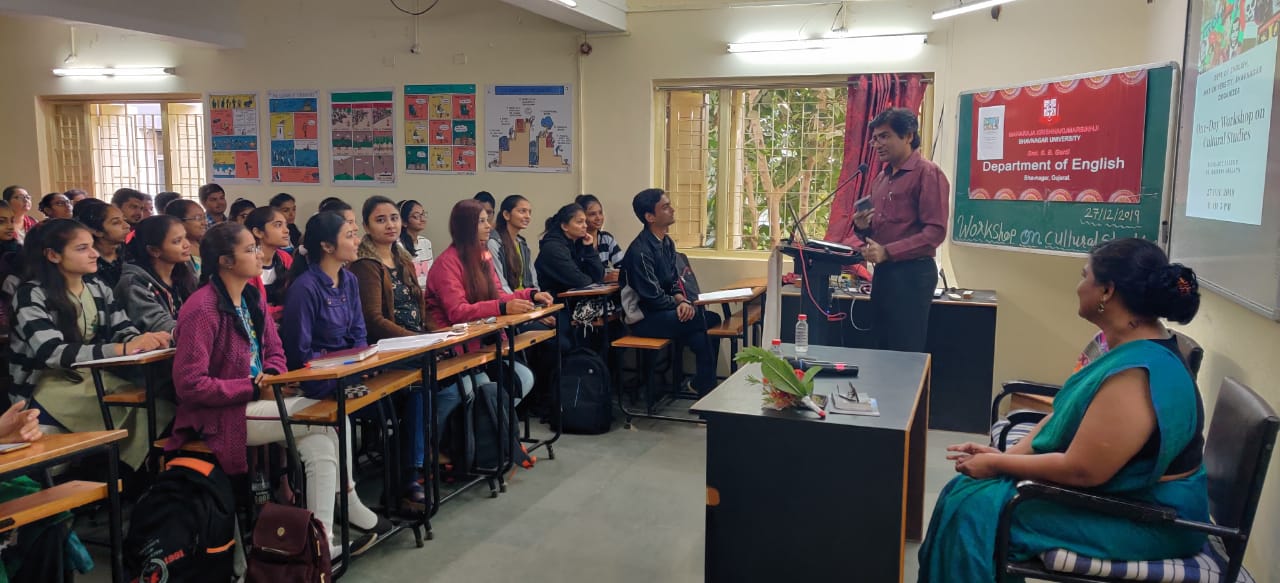
Today I'm present one more blog about Cultural Studies. Our Professor Dr. Dilip Darad sir organised session on Cultural Studies by Kalyanimam Vallath from Kerala. She have her own coaching centre Vallath TES in kerala and Kalkatta. Our professor Dr. Dilip sir organised her session at Department of English ( MKB Uni.) , Bhavnagar. In that session we learned about Cultural Studies and also she gave Information about NET & SET exam.


In this session she gave lots of information about Cultural Studies and NET & SET exam during her wonderful session. Cultural Studies simple meaning is who I'm ? And what I'm? 


1). What is your understanding about the concept of the Cultural Studies?
Answer : 
Cultural Studies related with Interdisciplin , larger society, individual experience , social theory , philosophy, social relatives, power relation, history , media, medical , politics, and linguistics. Cultural Studies means what I'm? and who I'm? Cultural Studies.


2). How would you explain a layman about Cultural Studies?
3). If you are asked on interview to teach Cultural Studies - how would you introduce it? 
As per my answer of Cultural Studies I tell them what we are and what is our space and how they survive in this world with rules and regulations that is Cultural Studies.

4). How many examples from the session were so catchy that you will never forget it? Write about it.
In her whole session she gave lots of example of her life, event, movie , drama , book. One example she give is " Shakespeare like 'sari' means Shakespeare represent the England, he try to express Culture of England.

Thank you....


Wednesday, December 25, 2019

Friendship

# Task given by Vaidehi Mam
# For Showing our Grammar mistake and writing.


Friendship is a relaxing of mutual affection between people. Friendship is a stronger form of if interpersonal bond than an association. Friendship has been studied in academic fields such as communication , sociology, social psychology, anthorpology and philosophy. Various academic theories of friendship have been proposed , including social exchange theory , equity theory ,relational dialectics and attachment styles.

Friendship is born in a million different ways, and all good friends strive to achieve the same goal to be a source of love and support. Finding a true friend feels like a gift that keeps on giving , even when they are thousands miles away. Through stressful classes, figuring out a career, and inevitable breakups, your best friends have been there. And yes, when you got those bangs you shouldn't have tried in the first place they consoled you.

Whatever

Monday, December 23, 2019

Shashi Tharoor

# Sahitya Academy 
# Thinking Activity 


Hello Reader....

I am back again to talk about a blog with you on Sahitya Academy award 2019. Shashi tharoor. This Blog task Given by our Professor Dr. Dilip Barad sir. Click here to visit Dr. Dilip sir's blog. He is giving that types of blog task for gaining some knowledge and have information about that.

Shashi Tharoor was born on 09- March - 1956 in London , England. He is the Prominent Indian diplomat and Politician who after along service in the international diplomatic crops, became an official in the government of India. He was also a highly regarded author of both nonfiction and fiction books.

He also serves as Chairman of the Parliamentary Standing Committee on External Affairs.Tharoor began as a career diplomat with the United Nations and went on to become its Vice-Secretary General. After contesting an election to the Secretary General's office unsuccessfully in 2006, he left the multilateral agency. He secured the Congress ticket from the Thiruvananthapuram Lok Sabha constituency in 2009 amid a lot of opposition from the Kerala wing of the party. He was in the news a couple of years ago after he won a debate at Oxford arguing that the British must pay reparations to its former colonies.

Tharoor won the election and was made a Minister of State for External Affairs in the Manmohan Singh Cabinet in the United Progressive Alliance I (UPA I) government. Despite being embroiled in a host of controversies, related to sweat equity in an Indian Premier League team and the suspicious death of his wife Sunanda Pushkar, Tharoor won a second term in 2014.

As he is quite popular among the urban youth, it will be interesting to watch how well he can pull that section of the electorate towards the Congress in Kerala.

Shashi Tharoor is the bestselling author of fifteen previous books, both fiction and non-fiction, besides being a noted critic and columnist. His books include the path-breaking satire The Great Indian Novel (1989), the classic India: From Midnight to the Millennium (1997), and most recently, India Shastra: Reflections on the Nation in Our Time (2015). He was a former Under Secretary-General of the United Nations and a former Minister of State for Human Resource Development and Minister of State for External Affairs in the Government of India. He is a two-time member of the Lok Sabha from Thiruvananthapuram and chairs Parliament’s External Affairs Committee. He has won numerous literary awards, including a Commonwealth Writers’ Prize, and was honoured as New Age Politician of the Year (2010) by NDTV. He was awarded the Pravasi Bharatiya Samman, India’s highest honour for overseas Indians.

Tharoor has kicked up quite a few controversies over the years. When Pranab Mukherjee initiated an austerity drive during UPA I, the former diplomat was found staying in a 5-star hotel for weeks. On Twitter, he ruffled feathers when he said he

"would travel cattle class out of solidarity with all our holy cows".

He was in the news a couple of years ago after he won a debate at Oxford arguing that the British must pay reparations to its former colonies of 18 bestselling works of fiction and non-fiction, Tharoor has been a vocal critic of the Narendra Modi government. He also penned a book recently about the failures of the present dispensation at the Centre.

Shashi Tharoor An author, politician, and former international civil servant, Shashi Tharoor straddles several worlds of experience. Currently a third-term Lok Sabha MP representing the Thiruvananthapuram constituency and Chairman of the Parliamentary Standing Committee on External Affairs, he has previously served as Minister of State for Human Resource Development and Minister of State for External Affairs in the Government of India. During his nearly three-decade long prior career at the United Nations, he served as a peacekeeper, refugee worker, and administrator at the highest levels, serving as Under-Secretary General during Kofi Annan's leadership of the organisation.

This book was published in 2017.  This was written in post colonial context. How the British empire is ruled on Indian people And also the thing is that how they make disastrous effect on in Indian Economy. In his interview we find that many argument that I like the most.

Videos of Shashi Tharoor.


That all are videos about Shashi Tharoor and he give speech about Looking Back at the British Raj in India: The University of Edinburgh.

He is write many books like An Dark Era of Inglorious empires.


In 1930, the American historian and philosopher Will Durant wrote that Britain’s ‘conscious and deliberate bleeding of India… [was the] greatest crime in all history’. He was not the only one to denounce the rapacity and cruelty of British rule, and his assessment was not exaggerated. Almost thirty-five million Indians died because of acts of commission and omission by the British—in famines, epidemics, communal riots and wholesale slaughter like the reprisal killings after the 1857 War of Independence and the Amritsar massacre of 1919. Besides the deaths of Indians, British rule impoverished India in a manner that beggars belief. When the East India Company took control of the country, in the chaos that ensued after the collapse of the Mughal empire, India’s share of world GDP was 23 per cent. When the British left it was just above 3 per cent.

The British empire in India began with the East India Company, incorporated in 1600, by royal charter of Her Majesty Queen Elizabeth I, to trade in silk, spices and other profitable Indian commodities. Within a century and a half, the Company had become a power to reckon with in India. In 1757, under the command of Robert Clive, Company forces defeated the ruling Nawab Siraj-ud-Daula of Bengal at Plassey, through a combination of superior artillery and even more superior chicanery. A few years later, the young and weakened Mughal emperor, Shah Alam II, was browbeaten into issuing an edict that replaced his own revenue officials with the Company’s representatives. Over the next several decades, the East India Company, backed by the British government, extended its control over most of India, ruling with a combination of extortion, double-dealing, and outright corruption backed by violence and superior force. This state of affairs continued until 1857, when large numbers of the Company’s Indian soldiers spearheaded the first major rebellion against colonial rule. After the rebels were defeated, the British Crown took over power and ruled the country ostensibly more benignly until 1947, when India won independence.

In this explosive book, bestselling author Shashi Tharoor reveals with acuity, impeccable research, and trademark wit, just how disastrous British rule was for India. Besides examining the many ways in which the colonizers exploited India, ranging from the drain of national resources to Britain, the destruction of the Indian textile, steel-making and shipping industries, and the negative transformation of agriculture, he demolishes the arguments of Western and Indian apologists for Empire on the supposed benefits of British rule, including democracy and political freedom, the rule of law, and the railways. The few unarguable benefits—the English language, tea, and cricket—were never actually intended for the benefit of the colonized but introduced to serve the interests of the colonizers. Brilliantly narrated and passionately argued, An Era of Darkness will serve to correct many misconceptions about one of the most contested periods of Indian history.

#Review of the Book.

‘Gifted writing, masses of dexterously marshaled information, pithily summarized ideas and a sharp debating style, which fences more with the sword than with the shield, make for riveting reading. Professors writing on colonial exploitation have suffered from the sadness of their subject. Tharoor makes it fun. By far the liveliest recent exposition of the traditional Indian nationalist viewpoint, his book can be recommended unhesitatingly…’
—India Today

‘Shashi Tharoor’s latest, An Era of Darkness, is one breathless read…Until [this book] came along, there was no single work that clearly and unambiguously catalogued all the harm done to India under British rule.’ —Business Line ‘The book serves to correct many misconceptions about one of the most contested periods of Indian history’.
—Deccan Chronicle

‘[Tharoor] has produced a bestseller that will re-ignite thinking and debate and open the eyes of the younger generation in India and hopefully in Britain on this “era of darkness’…Tharoor’s new contribution is that he even takes apart the commonly accepted argument…that the British Empire left quite a bit of good in India…’
—Business Standard

‘By rewriting the history of the British Raj as it really was, Tharoor has lifted a great load from millions of still-colonised minds in this country; while simultaneously providing an opportunity to the heirs of carpetbaggers and adventurers of the Raj to atone and apologize.’
—Education World

‘Tharoor reveals with acuity, impeccable research, and trademark wit, just how disastrous British rule was for India’
—The Sunday Guardian

‘Tharoor’s arguments have smashed to smithereens the claim that the British prepared India for a system of parliamentary democracy and laid the foundation for the rule of law…we all should be grateful to Tharoor for writing a book of enduring value, and it will be desirable to see it translated into different Indian languages as it is of interest to the public at large.’
—Frontline

‘Tharoor’s thrusts are painful, and his approach is that of a shrewd debater—which Tharoor excels at—attacking each proclaimed virtue from all fronts, leaving the supporter of the empire defenceless. He shows—with facts and statistics—how post-independence India has made rapid strides in economic and social development, which were simply impossible during the colonial era, and without stressing on the point too loudly, reminds the reader how much more India could have achieved had it been able to modernize without colonial subjugation’ —LiveMint

‘The reality is, as Tharoor points out, that “we were one of the richest countries in the world when the British came in but when they left us, we were one of the poorest.”
 —Mail Today

In An Era of Darkness, consummate debater and author Shashi Tharoor recreates the British Raj with all its horrors and also elucidates the awe-inspiring struggle of India's freedom fighters. He gives us a valuable insight on how dark forces operate and on who are harbingers of hope—it's a valuable lesson at a time when thugs are masquerading as our saviours…at a time when debate has been reduced to a cacophony of slogans and insults by bhakts, Tharoor's writing, with its expansive case studies and citations and sustained argument, all augmented by his felicity of language, may just come as an eye-opener to us all.
—Huffington Post


Sunday, December 22, 2019

John Keats

# John Keats
# Thinking Activity
# Paper -2 Romantic Literature


Hello Reader....

I welcome to all Reader on my blog. Today I'm write about John Keats and his poem on death and also some other writers poems. This blog task given by our Professor Dr. Heenaba Zala , click here for her blog post on John Keats. Today I'm talking about the concept of Death from his poems.

# Information about John Keats
Along with Lord Byron and Percy Bysshe Shelley, John Keats was one of the most prominent figures of the second generation of English Romantic poets. Keats died due to tuberculosis in 1821 at the age of only 25. His work was in publication for only four years and it was not generally well received by critics during his lifetime. The most famous and acclaimed poems of Keats are a series of six odes known as the Odes of 1819. However, his reputation grew after his death and by the end of the 19th century, he became one of the most beloved of all English poets.  Through his 1819 odes, Keats created a new type of short lyrical poem, which influenced later generations.The most highly regarded among these is To Autumn, which has been called one of the most perfect short poems in the English language.

# Concept of Death.

Death is not end of anything but death is the starting of everything. Death is not stopping life but death is starting new life. Death is the symbol of New starting. As North of Fray told in his eassy the concept of Tragedy is like Winter , because it is the fall of natura and we are also told that Death of things, but as we know cycle can't stop after this fall and Winter, Spring is come and Spring is the symbol of Birth. So that cycle of natura also follow that rules. And as we also know Death is the Bitter truth and people can't accept that Truth.

But Literature give permission to write about the Death and many writer wrote about the Death.

For the better understanding about the Death I paste here Video link.


After the understanding of Death I talk about what is the space in Literature.

Now I'm taking about the John Keats's Poem La Belle dame sans Merci.

O what can ail thee, knight-at-arms,
       Alone and palely loitering?
The sedge has withered from the lake,
      And no birds sing.


O what can ail thee, knight-at-arms,
       So haggard and so woe-begone?
The squirrel’s granary is full,
       And the harvest’s done.


I see a lily on thy brow,
       With anguish moist and fever-dew,
And on thy cheeks a fading rose
       Fast withereth too.


I met a lady in the meads,
       Full beautiful—a faery’s child,
Her hair was long, her foot was light,
       And her eyes were wild.


I made a garland for her head,
       And bracelets too, and fragrant zone;
She looked at me as she did love,
       And made sweet moan


I set her on my pacing steed,
       And nothing else saw all day long,
For sidelong would she bend, and sing
       A faery’s song.


She found me roots of relish sweet,
       And honey wild, and manna-dew,
And sure in language strange she said—
       ‘I love thee true’.


She took me to her Elfin grot,
       And there she wept and sighed full sore,
And there I shut her wild wild eyes
       With kisses four.


And there she lullèd me asleep,
       And there I dreamed—Ah! woe betide!
The latest dream I ever dreamt
       On the cold hill side.


I saw pale kings and princes too,
       Pale warriors, death-pale were they all;
They cried—‘La Belle Dame sans Merci
       Thee hath in thrall!’


I saw their starved lips in the gloam,
       With horrid warning gapèd wide,
And I awoke and found me here,
       On the cold hill’s side.


And this is why I sojourn here,
       Alone and palely loitering,
Though the sedge is withered from the lake,
       And no birds sing.

“La Belle Dame sans Merci” as a Representative of Deception: 

La Belle dame sans Merci" ( the beautiful lady without mercy) is a Ballad produced by the English poet John Keats in 1819. The title of the 15th - century Poem by Alain Chartier called La Belle Dame Sans Merci.

The poem narrates a tragic story of a knight who falls in love with a lady, but she leaves him as falls ill. A stranger meets the knight and inquires about his miserable condition. The knight tells him about the beautiful woman in the meadows. They have been in love as she has walked alongside him and sung beautiful songs for him. Once, she took him to her special place where he kissed her, and the calmness around made him sleep. He then dreamed strange people warning him about that fair lady. He woke up by the cold hillside where the stranger found him. The tragic ballad tells about the sad condition of the knight and the deception of the lady.

Metaphor: It is a figure of speech in which an implied comparison is made between the objects that are different in nature. For example, “I see a lily on thy brow”. Here the paleness is compared to a white lily.

Symbolism: Symbolism means to use symbols to signify ideas and qualities, giving them symbolic meanings different from literal meanings. The phrases such as; “no birds sing”, “lily on thy brow” and “fading rose” symbolize the arrival of death.

Imagery: Imagery is used to make readers perceive things involving their five senses. For example, “She took me to her Elfin grot”, “I saw pale kings and princes too” and “And there she wept and sighed full sore.”

After that example I give more examples about the death. Click Here for the death poems written by many famous writer.


Thank you.....

Reference
1. B.A material.
2 YouTube
3. Pic: Wikipedia
  https://www.yourquote.in/sejal_solanki31
4. https://dilipbarad.blogspot.com/2013/01/ma-english-study-material-reading.html?m=1


Sunday, December 15, 2019

Indian Poetics by Vinod Joshi

#  Indian Poetics
# Paper-3 Literary Criticism
# Guest Lecture by Vinod Joshi
# Gujarati Famous Writer and Poet.


Hello Reader...
 
    Today I'm writing about our Paper 3 Literary Criticism 's topic Indian Poetics. Our department arrange Guest Lecture for Indian Poetics by Professor Vinod Joshi Sir, he is great gujarati Writer and Poet, Currently he Write grate book 'Sairendhari'
Which is based on Mahabharata story. In that book Dropadi was not subltern but she is a powerful Character in this book.

First day he is starting with introduction of Criticism and Indian Poetics. On this day he talk about Introduction of Indian Poetics and about Muni like Abhinav Gupta , Vaman, Rajshekhar , Jagannath , Aanand vardhan etc.
          " Internal tools help you
             to understand Criticism."
In indian Poetics muni gives 9 Aesthetic for understanding writers feeling and also reader what he feel after read book. As we know Literary criticism is the Literary philosophy. As literature moves us to think and to critique it. It gives us new ideas and moves us to think differently. We gain knowledge and learn to live co-operatively with each other and understand them as co-operating with each other.

ભારતીય વિવેચન આપણને સૂક્ષ્મ અનુસંધાન અને જગત સાથે જોડાવા માટે મદદ કરે છે. આપણો ગમે તેવું કરવાનો અનુરાગ હોય છે અને આપણા ગમા-અણગમા ઉપર એનો આધાર રહેલો હોય છે. આને સમજાવવા માટે ભારતીય કવ્યા શાસ્ત્ર માં વિવેચક એક શ્લોક આપે છે.

कवि करोति काव्यानि, रसोन करोति कल्याणी , तरु सृजति पुष्पाणि।


ભારતીય મીમાંસા નો પ્રારંભ ભરત મુનિ એ કર્યો હતો. ભારતનો સાહિત્યપ્રેમી વિચાર એ રસ હતો. એમજ આનંદવર્ધન નો સાહિત્યપ્રેમી વિચારો ધ્વનિ, કુંતક નો વક્રોક્તિ, વામન નો રિતી, ભામન નો અલંકાર હતા.

Indian poetics is unique in the whole world.

ભાષા વગર વિચાર ના આવી શકે. - Palto
ભાષા પ્રાકૃતિક નથી. ભાષા નો આપડે ઉપયોગ કરીએ છીએ વાતચીત માટે. પ્રાકૃતિક આવાજ છે. ભાષા દ્વારા લાગણી, પીડા વગેરે વ્યક્ત કરી શકાય પણ કોઈ ને એનો અનુભવ ના થઈ શકે. કદાચ ભાષા ના હોત તો માનવી ક્યારેય ખોટું ના બોલી શકતો હોત. આપણે જે અર્થ પહોંચાડીએ તે ભાષા નથી પરંતુ જે બોલીએ છીએ તેના દ્વારા આપડે ખાલી ભાવ પહોંચાડીએ છીએ પણ ભાષા નહિ પહોંચાડી શકતા. આપણે વાત કરીએ ત્યારે આપડે કોઈ ને ભાવ પહોંચાડીએ છીએ ભાષા નહિ. આપડે અર્થ નહિ પરંતુ ભાવ દ્વારા ભાવ પહોંચાડીએ છીએ. ભાવ વિશ્વ એટલે અનુભવ નું વિશ્વ. ભાવ સૃષ્ટિ ને આધારે જ Indian poetics ની રચના કરી હતી. ભરત મુનિ દ્વારા રસ નિષ્પત્તિ ની પ્રક્રિયા વર્ણવી હતી. અને પાણીની દ્વારા વ્યાકરણ શાસ્ત્ર ની રચના કરવામાં આવી.

Language is a Imitation.  - Plato

રસ સંપ્રદાય

રસ સંપ્રદાય ની રચના ભરત મુનિ દ્વારા કરવામાં આવી હતી. અને નાટ્ય શાસ્ત્ર, નાટ્ય રસ , નો પણ તેમને ઉચ્ચાર કરેલો છે. કાવ્ય ને સંસ્કૃત માં સાહિત્ય કહેવાય છે. રસ નિષ્પત્તિ માટે શ્લોક પણ આપવામાં આવ્યો છે.


विभावानु भावव्यभिचारी संयोगात् रसनिष्पतः।

રસ સંપ્રદાય ચાર વિભાગ માં વહેચવામાં આવે છે.
1. વિભાવ
2. અનુભાવ
3. વ્યભિચારી ભાવ / સંચારી ભાવ
4. સંયોગ

1 વિભાવ
- જેના આધારે રસ નિષ્પન્ન થાય તેને વિભાવ કહેવાય. વિભાવ માં પણ અલગ અલગ પ્રકાર જોવા મળે છે. અને તેને અહીંયા ઉદાહરણ દ્વારા કહેવામાં આવ્યું છે.
* આલંબન વિભાવ  : દુષ્યંત અને શકુંતલા.
* ઉદિપન વિભાવ : વાતાવરણ

2. અનુભાવ
- અનુભાવ એટલે જેના દ્વારા પ્રતિક્રિયા જોવા મળે. અનુભાવ એટલે પ્રતિક્રિયા અર્થ પણ આપને લઈ શકીએ છીએ.
એક તરફ થી થતી ક્રિયા પર જે ભાવ જોવા મળે તેને પ્રતિક્રિયા કહેવામાં આવે છે.
* લજ્જા એ પ્રતિક્રિયા છે.

3. વ્યભિચારી ભાવ / સંચારી ભાવ
-  વ્યભિચારી ભાવ / સંચારી ભાવ આ ભાવ માટે એવું કહેવામાં આવે છે કે આ ભાવ આવે અને જાય. આ ભાવ બહુ લાંબા સમય સુધી ટકતો નથી. આ ભાવ ને વહેતો ભાવ પણ કહેવામાં આવે છે.

4. સંયોગ
- વિભાવ, અનુભાવ, વ્યભિચારી ભાવ / સંચારી ભાવ આ ત્રણેય ભાવ ના મિશ્રણ ને સંયોગ કહેવામાં આવે છે. આ ત્રણેય ભાવ ના સંયોગ ને થાય ત્યારે રસ નિષ્પત્તિ થાય છે. સંયોગ પરથી સંયોજન શબ્દ આવેલો છે.
* બાળક નું હસવું એ એના વિચાર માં નહિ પરંતુ એ દોષારોપણ થાય છે.

રસ ને નવ પ્રકાર માં વહેંચવા માં આવે છે. રસ એ સર્વસ્વ છે.
1. રતિ - શૃંગાર રસ
2. શોક - કરૂણ રસ
3. ઉત્સાહ - વીર રસ
4. ક્રોધ - રૌદ્ર રસ
5. હાસ્ય - હાસ્ય રસ
6. ભય - ભયાનક રસ
7. જુગુપ્સા - બીભત્સ રસ
8. વિસ્મય - અદભૂત રસ
9. શમા નિર્વેદ - શાંત રસ


शृंगार करुण विर , रौद्र हास्यं भयानकः ।
बिभंत्साद् भुतशाष्व, नव नाट्यं रसाः स्मृता ।


ચાર આલંકારિક
1. ભટ્ટ લોલ્લાર
2. શ્રી શંકુક
3. ભટ્ટ નાયક
4. અભિનવ ગુપ્ત

1. ભટ્ટ લોલ્લાર
- ભટ્ટ લોલ્લાર ને ઉત્પતિ વાદ તરીકે ઓળખવામાં આવ્યા છે. તેઓ એવું કહે છે કે રસ હોતો જ નથી. પરંતુ રસ ને ઉત્પન્ન કરવો પડે છે. અભિનય કરનાર ને રસ નો અનુભવ થાય છે.

2.  શ્રી શંકુક
-  શ્રી શંકુક એવું કહે છે કે રસ હોતો જ નથી. રસ ની ધારણા કરવી પડે છે. રસ નું અનુમાન કરવું પડે છે. તેમણે સૌંદર્યલક્ષી વિશે એક સિદ્ધાંત આપે છે. અને પ્રતીતિ પણ કરાવે છે. અને તેઓ પ્રતીતિ ના ચાર પ્રકાર આપે છે.
1. અર્થાર્થ પ્રતીતિ ( સંપક પ્રતીતિ )
2. મિથ્યા પ્રતીતિ ( રોલ કરતા રોલ કરનાર નું મહત્વ છે. )
3. સંશય પ્રતીતિ ( શંકા )
4. સાદ્રશ્ય પ્રતીતિ ( સમાનતા )

- અનુમતિ વાદ નો સિદ્ધાંત
- ચિત્ર તોરણ નું ઉદાહરણ

3. ભટ્ટ નાયક
- ભટ્ટ નાયક વિરેચન ની વાત કરી છે. ભટ્ટ નાયક ને એરિસ્ટોટલ ગમતા હતા.
- મૃદાલી - રડાવનાર સ્ત્રી , વિધવા સ્ત્રી, જ્યાં તે પોતાનું રુદન પ્રગટ ના કરી શકે ત્યાં રડવનાર સ્ત્રી ને મૃદાલિ કહેવામાં આવે છે.
- સાધરનીકરણ - રસ નો સૌથી મોટો સંચય છે.

4. અભિનવ ગુપ્ત
- અભિવ્યકિતાવાદ સિધ્ધાંત
- પ્રકાશ આનંદ જ્ઞાન નો અનુભવ આપે છે. રસ ના સિધ્ધાંત માં બધી જ સાહિત્યિક સિદ્ધાંત નો સમાવેશ થાય છે.


Thursday, December 5, 2019

I. A. Richards

#I. A. Richards 
#Thinking Activity
#Paper -3. Literary Criticism 


Hello Reader...

   Here I wrote about the grate critic and poet , I. A. Richards but he differs from the new critics is one important respect. While the New critics limit themselves rigorously to the poem under consideration. I. A. Richards also take into account it's effects on the reader.

His full name is Ivor Armstrong Richard ( 26 February 1893 - 7 September 1979) . He was the English educator, literary critic and rhetorician. As a thinking activity we have select one poem, song, devotional song or any poetic expression for verbal analysis. According to the I. A. Richard's essay on Figurative Language. Who has been highly influencial in developing a new way of reading poetry that lead to the new Criticism and that also influenced some forms of reader response.

Affective Criticism and laboratory techniques other forms of psychological Criticism. Richards' evaluation of various psychology views of art, his rejection of bedonism, of the specifically "aesthetic" emotion , of empathy , etc. In favor of synaesthesia. Criticism of Richards notion that the poise is in our response and not in the structure of the stimulating object, other theory are based on fusion , his Criticism of Eliot the resemblance and differences between the theories of Rechards and Eliot's.

In Plato's view that Poetry 'feeds and waters the passion" and in Aristotle's doctrine of catharsis. But in 19th century , the decay of metaphysics and the extraordinary growth of the physical science gave a special stress to affective theories.

Freud's theory of wit and the comic has been discussed in a preceding chapter. Though Freud did not apply his theory of wit directly to Literature , certain parallels clearly suggest themselves. The creation of Poetry like the creation of wit draws upon the unconscious , poetry and wit are both in some sense ' inspired .' Many of techniques of Poetry , like those of wit and dream , are evidently to be subsumed under a principal of condensation.

In which we find that four kinds of meaning like that :

1. Sense : sense is what is said and which is referred by writer.

2. Feeling :  feeling is referred various kind of emotions. Words express these feelings.

3. Tone :  Tone is the writer's attitude to his audience and readers.

4. Intention : Intention is the writer's aim, which may be conscious or unconscious. It refers to the effect that he tries to produce.


Analysis of Poem.


In this Gujarati poem poet talk about many things. He talk about crowds. In the beginning he told he can't go in crowd because he don't like, and thats why it is not possible. And he also talk he was not same as like other because he is he not anyone so. And in that lines he also shows his attitude and rich ness from others. 

In whole poem he talk about that types of things and he also analyse that types of things. In second stanza he told to some he Cheak his heart because he was not same like other. 

In third stanza poet talk about talking with some one but he can't understand him so Poet can't explain anything to him because he can't understand to Poet and his situation. That's why Poet can't explain anything to him.

In forth stanza he talk about the rain and also about soaked so poet told to him or her he don't show rain from inside but he like to soaked in rain so he go outside and he show the beauty of nature. 

In this lines poet talk about the detached of her because he like her and he cant go anywhere without her. So poet also told her he can't like to detached her and can't go anywhere. 

In last stanza he told he made him shiv like serious but he also criticize God and he told he can't do idol worship. And he belive in work not in idol worship. And in this poem poet criticize on many things as we show upper. So in this poem poet criticized on many things and he wrote great poem. In gujarati language. 

Thank you....


Monday, December 2, 2019

Arundhati Roy

# Thinking Activity 
# Sunday Reading
# Arundhati Roy 


Tap on Arundhuti Roy Photo and have a Blog link about Her. 


Hello Friends....

Here is my blog about the great Journalist Arundhati Roy. Task Given by Professor Dr. Dilip Barad Sir , Department of English , Maharaja Krishnakumar Singhji Bhavnagar University. In this Department we wrote many blogs about every thing. We use all the things and we also join many other online course like MOOC.

In this blog I wrote about the Indian Author Arundhati Roy.  Authors generally express their feelings and experiences through their best narrative style and storytelling. She is great Writer and she was very famous writer and also Actress and also political Activist.


Arundhati Roy , Full Name Suzanna Arundhati Roy, born in 24 - November - 1961 , Shillong , Meghalaya , India.
She is a Indian author , actress and political activist. She was best known for the Award - winning novel The God of Small Things written in 1997 and for her involvement in environmental and Human rights causes.

Roy’s father was a Bengali tea planter, and her mother was a Christian of Syrian descent who challenged India’s inheritance laws by successfully suing for the right of Christian women to receive an equal share of their fathers’ estates.

Awards & Honors :- 

1. The Booker Prize ( 1997 ).
2. The Sydney Peace Prize ( 2004 ).
3. The National Film Award for best                    Screenplay ( 1988 ).

Screenplay :- 

1. In which Annie gives it those once (1989).
2. Electric Moon (1992).

First play based on her experiences as a student of Architecture. Both plays are directed by her husband, Pradip Krishen, during the marriage.


 Notable Works :- 

1. The God of Small Things.
2. The Ministry of Utmost Happiness.


Arundhati Roy was a great writer, Screenplay Writer, actress , political activist. She is wrote about on politics and also about the situation of our political system. In her interview and also in her book or in her journalism life she is always against of politics. And she also talk about the cast system of India and also she told india divided in many cast. And also difference between touchable and untouchables and condition of untouchables after the partition of India. She also a Agitator and she do many Movements against the Government and politicians.

In her book "The God of Small Things" in this book she discribe real India or we can also told that Bed Situation of India. In this book she talk about the cast system, about the difference between Touchable and Untouchables , and talk about the religion and also about the religious people who blindly believe on God. In which she talked about untouchability, social exclusion, feminism, postcolonial cosmopolitanism and childhood experiences of fraternal twins, whose lives are destroyed by the ' love laws '. The novel highlights the situation of women in the society , about the rape cases , Murder, and etc. etc.


Her second novel The Ministry of Utmost Happiness (2017), highlights the orthodox mentality of people. She called Narendra Modi as Gujarat ka lalla, and Manmohan singh as Caged Rabbit, Kejarival as a Mister Aggraval. Thus she strikes on many political incidents. Here is the video best describes the content of her novel.


The novel weaves together stories of people navigating some of the darkest and most violent episodes of modern Indian history, from land reform that dispossessed poor farmers to the 2002 Godhra train burning and Kashmir insurgency. And in this time many movement happened in our country India and that time many people lost their lives.
Roy's characters run the gamut of Indian society and include an intersex woman (hijra), a rebellious architect, and her landlord who is a supervisor in the intelligence service. And because of that people feel bad for her because of this novel. And she face that problem also in her life. The narrative spans across decades and locations, but primarily takes place in Delhi and Kashmira and about terrorism attacks and many people lost their life in this attacks.

In last that is a difficult question for me to answer Arundhati Roy's perspective towards life. Because she done many works during her life and she play lots of characters in her life because she is actress , novel writer journalist , and she also wife , daughter , mother like many relations. So that's why I am not able to tell the purpose of her life.

Thank you....

Sunday, December 1, 2019

Mary - Jane

Thinking Activity : Mary shelly & Jane Austen


Hello readers...

My blog is related to the age of romanticism or 19th century literature. We are wrote this blog for our task. At the Department of English, many new learning methods are accepted. Through The audio visual presentation, students can learn thing tremendous fast. In order to understand the present topic. This task given by vaidehi Hariyani madam. As part of group activity. This task completed by Hitixa Goswami and Sejal Solanki. In this task we are done Audio and Video Conversation between Jane and Mary. They are Writer of Romentic Age. And they talk about their book. Here is the conversation between both woman Writer.

Jane Austen & Mary Shelley:


Mary Shelley :-
Mary wollstonecraft Shelley was an English novelist who wrote the gothic novel Frankenstein. 
English writer Mary Shelley is best known for her horror novel Frankenstein, or the Modern Prometheus (1818). She was married to poet Percy Bysshe Shelley.


Jane Austen:- 
Jane Austen was an English novelist known primarily for her six major novels, wich interpret, critique and comment upon the British landed gentry at the end of the 18th century.

Conversation :


This video about conversation between Mary Shelley and Jane Austen. Here is the video script about the video.

Video Script :-

 Jane Austen :- hello Merry

 Mary Shelley :-Hello

Jane Austen :- how are you?

Mary Shelley :- I'm fine.. What about you??

 Jane Austen :- I am also Fine. I read your famous novel Frankenstein in now a days.

 Mary Shelley :-Yes, that is good book and i talk in this book about the science experiment.

 Jane Austen :- Yes that is strong book. So, that's why people know you as British novelist And also you are short story writer, dramatic, essayist, biographer Writer and you are also best known for your experiment in and have modern ideas. I like your that spirit of writing.

Mary Shelley :-  All right you have lots of information about me great.

Jane Austen :- Ya I read your book and I also wish to meet you one time and today this wish is also complicate.

Mary Shelley :Ohh.! It's pleaser for me, I also want same reader. As like as you.

Jane Austen :- Thank you. But I also want to talk with you more things.

Mary Shelley :- sure you can do this..

Jane Austen :- I feel great talk with for my books.

Mary shelley:I know your such things but if you ask than I also like to know about you.

Jane Austen :- sure I feel proud to do this. I wrote pride and prejudice.

Mary Shelley :-  I some thing know about pride and prejudice it is most famous novel pride and prejudices.

Jane Austen :- yes pride and prejudices is the story of Mr. And Mrs. Bennet and their five unmarried daughters.

Mary shelly :- Pride and prejudice is a great story but. I don't read this story and I don't know what the purpose of this story so can you explain this.

Jane Austen :-  In this novel biggins with MR. & Mrs. Bannet and their unmarried five daughters thay live in the estate of longbouurn rn in Hertfordshire.
  This is intresting sting story about Mr. And Mrs. Bannet you can also read this book this is intresting book. If I told whole story about the book that you can can't have any intrest in Book so you can read this book.

Mary Shelley :- Sure, ofcourse I will read this book. Thank you.

Jane Austen :  Your Welcome.

Mary shelley :-  Nice to meet you.


Thank you.....


Dr. Baba Saheb

 Hello Friends... Welcome to my new blog, but first of  I apologize for not posting blogs in mid time. Today I'm talking about our natio...